AI adoption is growing. Value is not automatic.
Thinking about adding AI to your business, or changing how you already use it? Either way, the hard part is not the technology. It is knowing where AI actually pays off. TWINE is how we find out, so you leave with concrete decisions about what to pursue.
The gap between adoption and value.
Adoption is growing, especially among mid-sized companies. But only a small group generates value at scale, and getting there requires changing the work around the technology.
of HR leaders say workflows and roles must change to get the most from AI investment.
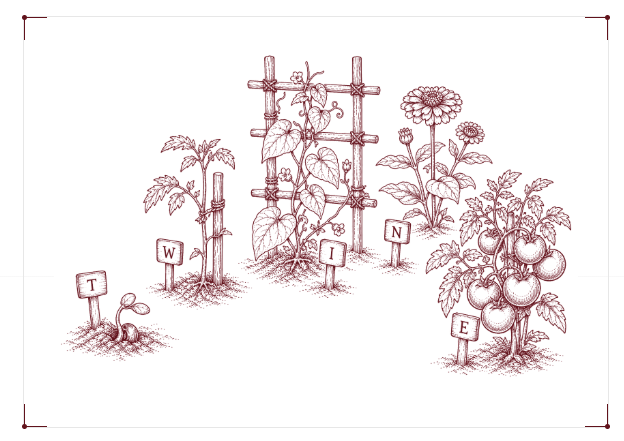
Gartner survey of 110 CHROs, 2026Value grows when AI runs through every layer of a business, instead of staying stuck in one isolated application. That takes coherence, not more technology, which is why we built a framework for it. en:twine means to weave threads together, and with TWINE you weave AI into your organisation layer by layer. Underneath those five layers, we decide which initiatives are worth pursuing. Two conditions always apply: People and Governance. Three gates screen the rest: stop what is not promising, prove what works, and decide which risks are acceptable.
Every layer is worked through in the playbook, with two real company examples. View the playbook
Five layers, each a different way AI creates value.
Transform
automate what you already do
AI takes over the repetitive manual work and removes the errors in it. The day-to-day engine, and the easiest place to start.
Weave
connect what's disconnected
Connect separate systems so information can flow freely and AI can use the right data. AI is only as good as the data it can reach.
Innovate
build what's missing or newly possible
Make new services and new kinds of reach possible: becoming visible in AI answers, developing AI-native products, or speeding up research with agents.
Niche
defend what's yours
Turn your expertise, data, and market position into a lasting advantage that competitors cannot easily copy.
Expand
scale what works
Increase the capacity of a proven way of working without growing your team at the same rate. This is where the chance of return is greatest.
Two conditions over all five layers.
A few checks before pursuing an initiative.
People
Every initiative supports the people doing the work and is designed to be adopted by them. Augment, don't replace: AI drafts, a person approves. Adoption is the silent killer, so the solution must fit the workflow people already use.
Governance
Every initiative is safe, compliant, and governed from day one, not bolted on at the end. We define who the AI may act for, which information and systems it may access, what is logged, and where human approval is required for anything irreversible. EU AI Act readiness is built in.
Kill
Say no early; it protects the success rate. Stop if the data cannot be made usable within scope, the decision requires context AI cannot access, the process changes weekly, or several suppliers have already failed without a clear reason why this attempt would be different.
Proof
Nothing ships without a day-one baseline metric, captured before launch. That baseline is the real answer to the question you will be asked in six months: what was the ROI?
Risk
The consequences of an error determine how much oversight is needed and in which order we roll out. Reversible, internal applications can move faster. Irreversible or customer-facing decisions require human approval. We reduce risk internally before customers are affected.
Concrete decisions, not a wish list.
Each initiative names its layer, its scope, what stays human, and the metric we will judge it on. That is the output of a TWINE session: a prioritised roadmap of concrete AI initiatives, each with clear guardrails and a measurable outcome you can hold us to.
The five layers, the overlays, and the gates, with two worked examples from real companies.